



From Quantum Strings to a Utopian Earth: How Author Rodney Bartlett is Rewriting the Cosmic Narrative
by Olivia Grace
Jun 22, 2026
eBook Radio Newsletter Feature, in collaboration with The Sacramento Bee newspaper
What if the universe isn’t a cold, accidental expanse of matter born from a violent explosion, but an interconnected digital masterpiece designed to guide humanity toward peace?
For the past twenty years, independent researcher and author Rodney Bartlett has quietly engaged in a monumental intellectual quest. A member of the Information Physics Institute and a dedicated contributor to ResearchGate, Bartlett has spent two decades tracking the evolution of physics, mathematics, and human destiny across 19 published books.
Now, in 2026, his life’s work has culminated in his most profound and daring text yet: Theoretical Horizons: New Hypotheses in Quantum and Astrophysical Research Leading to a Utopian Earth.
We sat down with Bartlett for an exclusive, deep-dive written interview to unpack his mind-bending theories, the secret binary code of the universe, and his radical vision for a world without hunger, poverty, or war.
1. Warming Up the “Cold Data” of Science
For many, modern physics is a labyrinth of unyielding equations and clinical observations. But Bartlett insists that true understanding requires a human touch.
“Most of the time, I don’t like to use equations, understanding them takes all the energy in my brain,” Bartlett shares candidly. “Cold data is indeed essential to understand quantum and astrophysical phenomena… but many members of the public want to ‘warm up’ the cold data. One way to do this is to link the quantum and astrophysical worlds to human feelings and dreams.”
By intentionally bridging the subatomic and the cosmic to human emotion, philosophy, and even spirituality, Theoretical Horizons brings abstract science “down to earth.” Structured as a collection of short, self-contained articles, the book allows readers to explore avant-garde theories without becoming lost in academic jargon.
2. The Heart of the Cosmos: Absolute Interconnectedness
When asked what lies at the very core of Theoretical Horizons, Bartlett pointblank refuses to narrow it down to a single piece of data. Instead, he points to a singular, striking hypothesis: Everything and everyone is intimately connected across space and time.
This isn’t mere mysticism; Bartlett builds his ideas on the cutting edges of theoretical physics, specifically quantum entanglement, String Theory, and Quantum Gravity.
In a brilliant conceptual update, Bartlett proposes that the controversial “strings” of String Theory aren’t just loops of energy, but strings of binary digits, the fundamental ones and zeros of electronics.
“Now, this book could be seen as redefining Strings as strings of electronics’ binary digits of one and zero,” he explains. “String theory may be able to be updated to a little bit of the 22nd century dropping into the 21st.”
3. Rewriting Reality: Why the Big Bang May Be a Century-Old Illusion
Perhaps the most controversial prediction Bartlett makes in Theoretical Horizons is the imminent demise of the Big Bang theory. He predicts that within the next decade, the scientific community will pivot back to a pre-Big Bang cosmological model: an infinite, eternal universe.
To explain how reality functions without a singular beginning, Bartlett leans heavily into profound mathematical frameworks. He bridges the historical gap between Leonhard Euler’s 18th-century work, Bernhard Riemann’s 1859 hypothesis, and 20th-century Wick rotation.
By integrating Euler’s identity, where e^i\pi represents continuous rotation around a complex plane, into the full equation:
e^i\pi + 1 = 0
Bartlett argues that this continuous rotation generates zero continuously. When applied to space-time, this elegant interaction implies a cosmos that is entirely flat, “simply connected,” and mathematically infinite in both space and time.
4. The Digital Path to a Worldly Utopia
Bartlett’s science is inextricably linked to his sociology. In the second half of Theoretical Horizons, he outlines how recognizing this underlying “binary software” of the universe will fundamentally reshape human behavior.
If every elementary particle, object, and person is programmed by the same cosmic source code, then humanity is entirely unified.
“The digits interconnect every person, object, and event in the same way that everything in a computer game appears to be separate but is actually part of one display determined by the programming,” Bartlett writes. “If everyone in this display is forever joined to any other individual, going to war and shooting somebody else is the same as shooting yourself.”
While today’s technology is trapped in a bottleneck unable to detect components smaller than elementary quarks, Bartlett relies on patience and historical precedents like Planck’s Principle to usher in this paradigm shift. He believes that as new generations of scientists emerge, the standard models will transform, paving the way for a literal Earthly Utopia with no hunger, no poverty, and world peace.
5. A 100-Year Legacy of Meaning and Purpose
As space exploration hits historical milestones with NASA’s ongoing Artemis program, Bartlett finds himself constantly pushed into what he calls “Star Trek mode” envisioning a thousand years into the future where instant intergalactic travel and time manipulation become tangible realities.
Ultimately, Theoretical Horizons is an exploration of legacy, meaning, and cosmic purpose.
“Scientists, philosophers, and ordinary people are looking for meaning and purpose in the universe which has been traditionally either denied or assigned to religion,” Bartlett concludes. “I think acceptance of these ideas will point the way for the world to get back on track to its destiny.”
For readers ready to challenge the boundaries of space, time, and their own place in the universe, Rodney Bartlett’s 20-year intellectual evolution offers a hopeful, breathtaking view of tomorrow.
Written interview about Amazon's book "Theoretical Horizons".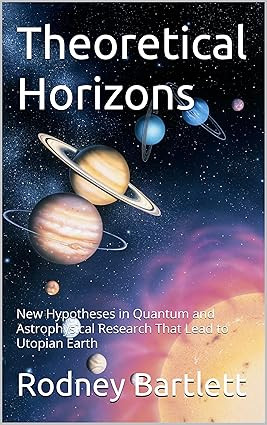
Welcome Visitor 9
To distribute this article more widely To manage this article or write your own article simply LOGIN
| ||||
